
Best Time to Visit Cape Town and Kruger: An Honest Month-by-Month Guide
Jul 8
14 min read
By Craig Howes, Founder and Editor | Updated July 2026
I live in Cape Town and I grew up in Hoedspruit, on the western edge of Greater Kruger. This guide is independent: no company paid for inclusion, and nobody is paying me to recommend a season.
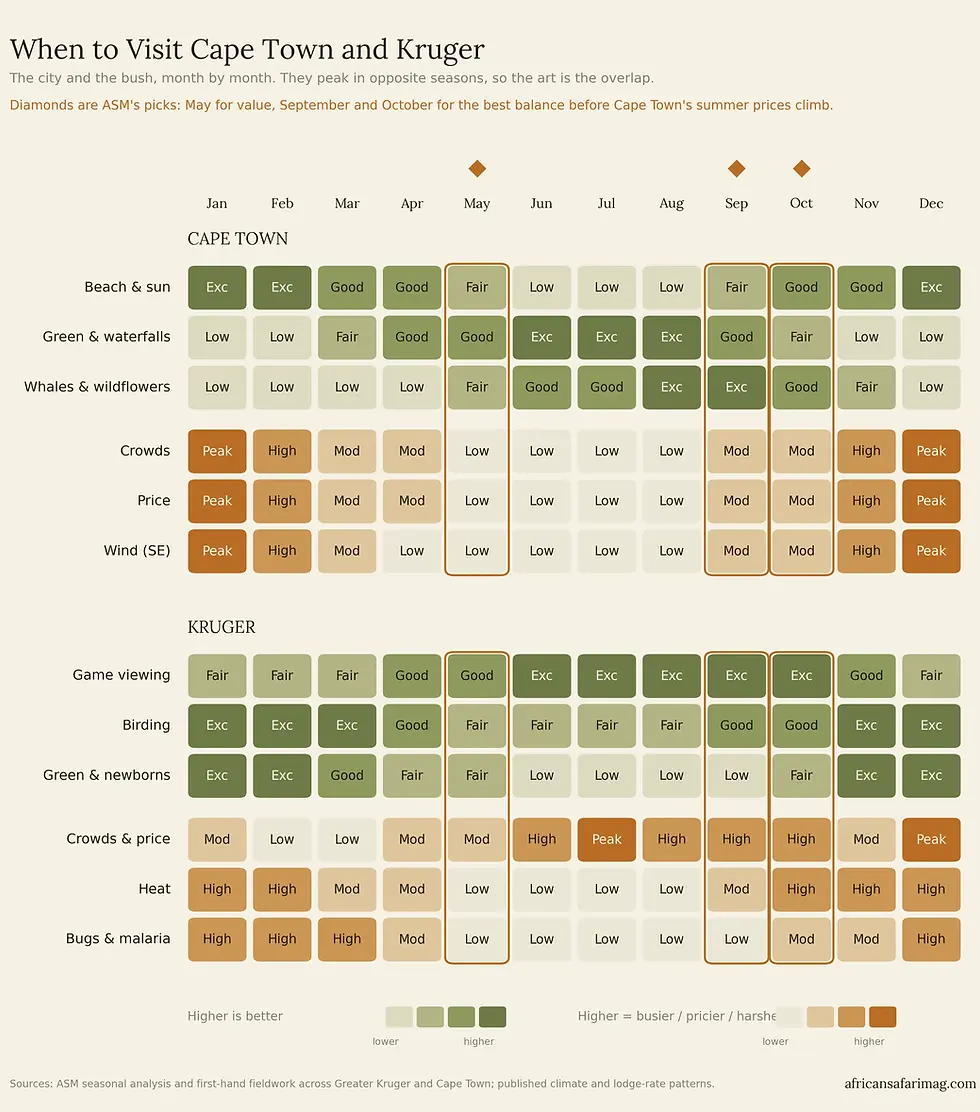
The short answer: The best time to visit Cape Town and Kruger is September and October, when Kruger's game viewing is at or near its dry-season peak and Cape Town is warming into spring with whales in the bays and wildflowers up the West Coast, before summer prices arrive. May is the value window: low crowds and shoulder rates on both legs. There is no single perfect month, because the two places peak in opposite seasons, and this guide is about managing that trade-off rather than pretending it away.

The problem nobody tells you about
Cape Town and Kruger have opposite rainfall seasons. Cape Town gets its rain in winter, roughly May to August. Kruger gets its rain in summer, roughly October to March. So when Cape Town is at its beach-weather best in December and January, Kruger is hot, green, stormy and thick with vegetation that hides the animals. And when Kruger is at its dry-season best in July and August, Cape Town is in the middle of its rainy season.
That single fact explains why "when should we go?" has no clean answer for this trip, and why most of the generic advice you'll read (Cape Town in summer, Kruger in winter) is useless for anyone trying to do both in one itinerary. The real question is where the overlap is acceptable, and what you're willing to trade on each leg.
One more thing before the month-by-month. Neither place has a bad season, only different seasons. Cape Town in winter is green, quiet and cheap, with waterfalls running on the mountain and some of the best restaurant specials of the year. Kruger in summer is dramatic, full of newborn animals and migrant birds, with afternoon thunderstorms that are genuinely beautiful to watch from a lodge deck. "Best time" means best for what you want, which is where we start.

First, decide which half of the trip matters more
When someone asks me when to do this trip, my first question back is always the same: is this a safari with Cape Town attached, or a Cape Town holiday with a safari attached? The answer changes the month.
If the safari is the point, aim for Kruger's dry season, May through early October, and accept Cape Town as it comes. Winter Cape Town is a softer, cosier city (the sun comes up after eight and it's dark before six, and the whole place turns green), but it is not beach weather.
If Cape Town is the point, aim for its summer, November through March, and accept a green-season safari. You'll still see plenty (a good summer drive in the Sabi Sands can deliver intense predator action), but sightings take more work in thick bush, the heat is serious, and you'll share the Lowveld with more mosquitoes.
If you want the best of both, that's the shoulder windows, and it's what the rest of this guide is really about.
PLANNING A CAPE TOWN AND SAFARI TRIP?
This guide covers when to go. For how to structure the trip itself, routes, flight gateways, and how many nights to give each leg, read: Cape Town and Safari: How to Plan the Trip You're Actually Trying to Take. If you're not sure Kruger is the right safari for your trip at all, start with the South Africa safari guide to compare regions.
Want help deciding?
We review your trip idea and match you with the right specialist. Free, no obligation.

Best time to visit Cape Town and Kruger, month by month
The two windows I'd actually book
September and October: the balance window
This is the pick if you're pushed for one answer, and it's when I tell friends and family to come. On the Kruger side, the bush has been drying out since May. Grass is low, the bush is open, and animals concentrate around the remaining water, which is exactly what makes dry-season game viewing easier. September is peak or near-peak viewing. October still delivers superb sightings, with a caveat I'll be honest about: it's the hottest, most airless time of year in the Lowveld, the first storms can arrive late in the month, and SANParks counts October as the start of the rainy season. Early October is a safer bet than late.
On the Cape Town side, spring is a quietly brilliant season. Southern right whales are still in the bays (the season runs roughly June to November, with the best viewing August to October), the West Coast wildflowers peak from mid-August to mid-September, the winter rain is tailing off, and you're ahead of the December price surge. The famous south-easter wind starts building through spring, but it's nothing like its January peak.
The honest trade-off: Cape Town in September is not beach weather. It's 16 to 18 degrees, changeable, and the sea is cold. You're trading beaches for whales, flowers and value.
May: the value window
May is the smart-money month. Cape Town's crowds are gone, winter restaurant and accommodation specials are starting, and the wind (the one thing that can genuinely ruin a Cape Town day) is at its calmest. The first proper rain is arriving, but between fronts you get still, golden autumn days that locals privately consider the best weather of the year.
In Kruger, May is the turn of the season. The rain has stopped, the bush is thinning by the week, mosquito pressure is dropping fast, and lodge rates are still in shoulder territory before the June to August peak. Game viewing is good and improving rather than at its maximum, and the mornings are getting properly cold. Pack warmer layers than you think you need for the open vehicle.
The honest trade-off: you're accepting "very good" rather than "peak" on both legs in exchange for the year's best pricing and thinnest crowds. For most travellers that is an excellent deal.
The conditional months
March and April
March and April are Cape Town-first months. The city is still warm, the summer crowds have left, and the light is beautiful. Kruger is coming off its rainy season: green, full rivers, weaker visibility than winter, though improving through April as the bush starts to thin and the heat eases. If the city is the priority and the safari is the add-on, March is lovely. If the safari is the reason for the trip, wait.
November
November is the mirror image. Cape Town's weather is genuinely attractive, but the south-easter is becoming a daily factor and prices are climbing toward the December peak. Kruger's wet season is established: thicker bush, higher malaria caution, brilliant birding as the summer migrants settle in. It works if you're optimising for Cape Town and you're relaxed about a greener, harder-working safari.
June to August
June to August is the safari-first window. Kruger is at its dry-season best: peak visibility, cool dry days, minimal mosquitoes, and the July school-holiday crowds as the one downside. Cape Town is in full winter. I'll defend winter Cape Town to anyone (green mountains, waterfalls, log fires, empty restaurants running specials, whales arriving in the bays from June), but you have to want that version of the city. August adds the start of the wildflowers, which is a genuine draw.
December to February
December to February is the hardest combination and I'd steer most people away from it. Cape Town is glorious and hectic: peak heat, peak crowds, and accommodation prices that can triple against the winter floor. Kruger is at its most challenging: extreme heat, dense bush, peak malaria season, and real rain. The January 2026 floods closed sections of the park and washed out roads, which is the extreme end of what a wet-season summer can do.
If your dates are fixed to a December or January school holiday, the trip still works (this is when many South African families travel), but go in with your eyes open: it's the most expensive version of Cape Town and the most compromised version of Kruger in the same itinerary.
“We travelled in early October and it was magical. Lions in the morning mist in Kruger, then back to Clifton sunsets and wine tastings. The contrast made the trip unforgettable.” Grace M, ASM Guest
Cape Town through the year, briefly
Cape Town runs on a Mediterranean clock. February is the driest month at around 16 mm of rain; June is the wettest at around 112 mm. Summer highs sit in the low 20s Celsius; winter highs around 15 to 17.

The variable nobody warns you about is wind. The south-easter, locally the Cape Doctor, is a summer phenomenon that can blow hard for days, close the Table Mountain cable car, and turn a beach afternoon into a sandblasting. It generally builds from late spring and peaks in mid-summer, with January usually the windiest month, and May and June the calmest. If your image of Cape Town is a still, hot beach day, know that the stillness is the rarer part of that picture in high summer.
Prices follow the sun. December and January are peak season, with accommodation at its most expensive and availability genuinely tight. March is the start of shoulder season. Winter, June through August, is the value floor, and the city rewards it with green landscapes, running waterfalls and restaurant specials.
Kruger through the year, briefly
The Lowveld runs on the opposite clock. Rain falls from roughly October to March; May to September is dry. Summer days regularly top 32 degrees with high humidity; winter days are mild and dry, around 26, with cold early mornings that can touch 5 degrees.
For game viewing, the dry winter wins on visibility and it isn't close. Thin bush, low grass, and wildlife concentrated at water make June to early October the easiest, most productive viewing of the year. Summer counters with its own rewards: the bush turns emerald, impala and wildebeest drop their young, the summer migrant birds arrive from November to March, and the afternoon storms are spectacular. Sightings still happen (leopards don't emigrate in November), they just take more work.

Two practical summer factors deserve plain language. Malaria risk in Greater Kruger is seasonal: it rises from October, peaks around January and February, and drops to its lowest from about May to September. And summer means bugs generally, mosquitoes among them. If either matters to your party, the dry season solves both, or a malaria-free reserve like Madikwe solves it year-round.
One distinction most timing guides skip: public Kruger and the private Greater Kruger reserves don't experience the seasons equally. In public Kruger you must stay on the roads, so when the summer bush thickens, your viewing thins with it. In the private reserves (Sabi Sands, Timbavati, and the other Greater Kruger concessions), guides can track off-road, which claws back a real share of what the green season takes away. If you're set on a summer safari, the private reserves are worth their premium in that season specifically.
A small personal note on winter mornings, because nobody ever mentions it: game drives leave about half an hour before sunrise. In summer the Lowveld sun rises brutally early, which means alarm clocks starting with a four. In winter, sunrise is civilised and so is your wake-up. It sounds trivial until day three.
Best time to visit Skukuza
Skukuza gets its own answer because it's the camp people actually search for, and because its situation is specific. It's Kruger's largest rest camp and the park's administrative heart, sitting on the southern bank of the Sabie River, one of the park's few perennial rivers. That riverfront position is why southern Kruger around Skukuza holds game so well in the dry season: when seasonal water disappears elsewhere, the Sabie keeps flowing and the wildlife keeps coming.
So the best time for Skukuza is the same dry-season logic, concentrated: May to early October, with July to September the peak. The river frontage makes even the transition months productive.
The counterweight is that Skukuza sits in the wetter southern half of the park, and in an exceptional wet season that's operationally exposed. The January 2026 floods forced access changes via Paul Kruger Gate and closed the park to day visitors for a period. A normal summer is fine, just hot and green; an extreme one can disrupt plans.
Skukuza also has the practical advantage that matters most for this trip: direct flights from Cape Town, roughly two and a half hours, which make the city-to-bush connection a same-morning hop instead of a travel day. Hoedspruit and Nelspruit (KMIA) offer the same from Cape Town for the central and southern reserves.
What the trip costs, and the trick with the average
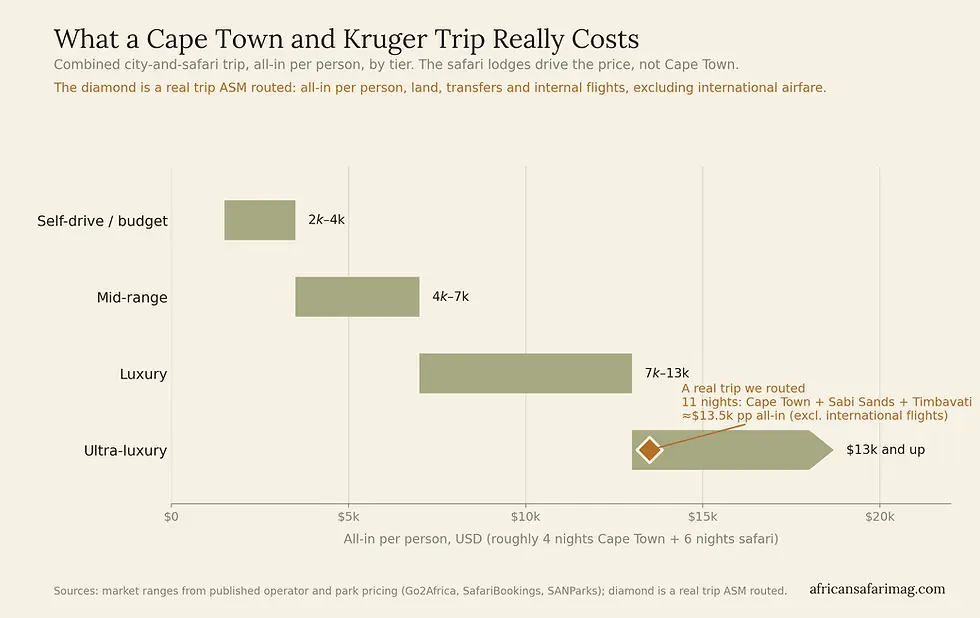
The tiers run roughly like this for a ten-night trip, per person, excluding international flights. Self-driving public Kruger with SANParks camps and a modest city stay: $1,500 to $3,500. Mid-range, with a private lodge and a good boutique hotel: $3,500 to $7,000. Luxury: $7,000 to $13,000. Ultra-luxury, meaning the Sabi Sands flagships: $13,000 up, and well up. Packaged combined trips from the big operators typically land at $200 to $500 per person per day before you reach the luxury tiers, and private-reserve lodges alone run from about $450 to over $1,500 per person per night depending on season.

Season moves the number the way you'd now expect. Cape Town gets materially more expensive from December to February, and Kruger's private lodges price hardest in the dry-season peak and school holidays. Which is one more argument for May and September: you're on the right side of both price curves at once.
Now the part that surprises people. Adding Cape Town to a luxury safari makes the average night cheaper, not more expensive. A genuinely excellent Cape Town boutique hotel costs $200 to $400 a night for the room. The safari lodge in the same itinerary costs $1,000 to $2,500 per person per night. On that real 11-night trip in the figure, the four city nights cost a fraction of the seven bush nights; the blended cost came out near $1,230 per person per night, well below what the same travellers would pay per night on a pure Sabi Sands trip. Cape Town nights sit at the cheap end of the blend, so every one you add stretches the trip without scaling the price.
The practical implication runs against most people's instinct. If the budget is fixed, cutting Cape Town nights to fund more lodge nights is the expensive trade; the city nights are nearly free by comparison. The cheaper way to make the trip longer is more Cape Town, not less.
Should you start or end in Cape Town?
You'll read confident rules about this. I'll give you the honest version: there's no rule, only a trade-off, and real trips run both ways. Plenty of itineraries we see start with Cape Town and end in the bush.
The case for starting in Cape Town: you land from a long-haul flight into a city, not a 4:30 wake-up. Cape Town absorbs jet lag gently (sea-level, good coffee, no schedule), and you arrive at your lodge rested, which matters because safari days are genuinely tiring. The case for ending in Cape Town: you finish the trip somewhere you can decompress, and you're positioned for a simple final departure from a major international airport.
The tiebreaker is usually flights. The Cape Town to Skukuza departure leaves mid-morning, which pairs neatly with a night in the city rather than a same-day long-haul connection. Work backwards from the flight that connects your two legs, and let that decide the direction.
Frequently asked questions
What is the best month to visit both Cape Town and Kruger?
September, with October close behind. Kruger's game viewing is at or near its dry-season peak while Cape Town moves into spring, with whales, wildflowers and pre-summer prices. May is the best value month: shoulder rates and low crowds on both legs, with very good rather than peak conditions in each.
Is Kruger better in winter or summer?
For game viewing, winter, and it isn't close. The dry season (May to September) means thin bush, low grass and wildlife concentrated at water. Summer counters with lush scenery, newborn animals, spectacular birding and dramatic storms, but sightings take more work in thick vegetation, the heat is intense, and malaria risk is higher.
When is the best time to visit Cape Town on its own?
For beach weather: late January to March, after the peak December crowds, with March the sweet spot. For value: winter, June to August, when the city is green, quiet and cheap. For whales and wildflowers: August to October. Cape Town has no bad season, only different ones.
What is the best time to visit Skukuza?
May to early October, with July to September the peak. Skukuza sits on the perennial Sabie River, so the surrounding southern Kruger holds game exceptionally well as the dry season concentrates wildlife at water. Direct flights from Cape Town (about 2.5 hours) make it the easiest Kruger gateway for a combined trip.
How many days do you need for Cape Town and Kruger?
Seven to ten nights is the realistic range: three to four nights in Cape Town and three to five on safari. Three nights is the minimum for a proper safari rhythm. If you're adding Victoria Falls, plan ten to twelve nights total.
When is malaria risk highest in Kruger?
During the rainy season, roughly October to April, peaking around January and February. Risk is at its lowest from about May to September. Greater Kruger is a low-risk zone rather than a high-risk one, but if you want zero risk, choose a malaria-free reserve such as Madikwe or the Eastern Cape reserves.
Is Cape Town worth visiting in winter?
Yes, if you want that version of the city. Winter Cape Town is green and quiet, with waterfalls on the mountain, whales arriving in the bays from June, restaurant specials everywhere and the year's lowest prices. It is not beach weather: expect 15 to 17 degree days, real rain between clear spells, and short daylight hours.
Does adding Cape Town make the trip more expensive?
It raises the total but lowers the average cost per night, because good Cape Town hotels cost a fraction of safari lodges. On a luxury trip, city nights at $200 to $400 blend against lodge nights at $1,000 to $2,500 per person, so extra Cape Town nights stretch the trip cheaply. If the budget is tight, trim lodge nights before city nights.
Still deciding?
If you know your dates and want the trip built around them properly (the right reserve for the season, the right nights split, flights that connect cleanly), tell us what you're planning.
We review your enquiry and match you with the specialist best suited to your trip. Free, no obligation.
“Planning our trip was overwhelming at first, but African Safari Mag made it simple. Their guides gave us clarity on when to go, where to stay, and what to pack. We’re already planning a return.” Melissa F., NYC - ASM Guest
About this guide
Written by Craig Howes, Founder and Editor of African Safari Magazine. I live in Cape Town and grew up in Hoedspruit, on the boundary of Greater Kruger. I've done Kruger and Greater Kruger in every season and every format: self-drive and SANParks rest camps, camping, luxury concessions and the Sabi Sands. The seasonal judgments here are mine, from that experience, cross-checked against published climate records, SANParks data and current operator pricing. No company paid for inclusion in this guide, and the seasonal picks are not influenced by any commercial relationship.


Comments