
Cape Town to Okavango Delta: How to Plan the Iconic Combination
Jul 9
18 min read
By Craig Howes. Updated July 2026.
The Cape Town to Okavango Delta trip pairs Africa's most beautiful city with its greatest inland wilderness, connected by a single direct flight of about two and a half hours. Most travellers spend three to four nights in Cape Town and four to six nights in the Delta, flying Cape Town to Maun and then by light aircraft into camp the same afternoon. The sweet spot for the combination is September and October, and a well-built trip runs from around $8,000 per person at the accessible end to $30,000 and beyond at the top.
I live in Cape Town and I have done this trip myself, most recently with two stays at Atzaro Okavango in 2025. The contrast still gets me. You can have breakfast looking at the Atlantic and fall asleep that night to hippos grunting in a lagoon. Very few pairings on the continent deliver that much change in a single travel day, and almost none do it this comfortably.
This guide covers how the routing actually works, how long you need on each side, when to go, what it genuinely costs, and three real itinerary shapes at different budgets. If you are still deciding which safari to pair with Cape Town in the first place, Kruger and Victoria Falls are also strong answers, and our Cape Town and safari guide compares the options. This page is for the trip most people end up dreaming about.
PLANNING A CAPE TOWN AND OKAVANGO TRIP?
This guide gives you the route, the timing, and honest costs. If you want the Delta camps compared in depth, read our guide to the best Okavango luxury lodges. And if you would rather hand the logistics to someone who builds this trip for a living, use Plan African Safari. We review your enquiry and route it to the planner best suited to your trip. Free, no obligation, and we only earn a commission if a booking results.
Why this combination works
Plenty of safari pairings exist on paper. This one works in practice, for four reasons.
The contrast is the point. Cape Town gives you mountains, ocean, wine farms, and one of the best food scenes in the southern hemisphere.

The Delta gives you 15,000 square kilometres of channels, floodplains and islands with some of the densest big-game viewing in Africa and almost nobody else around. Neither dilutes the other. City fatigue and bush fatigue are different kinds of tired, and each side cures the other.

The logistics are genuinely easy. One direct flight connects them. Both run on the same time zone, so the only jet lag you deal with is your international arrival, and Cape Town is a far kinder place to recover from a long-haul flight than a safari camp with a 5:30am wake-up call.
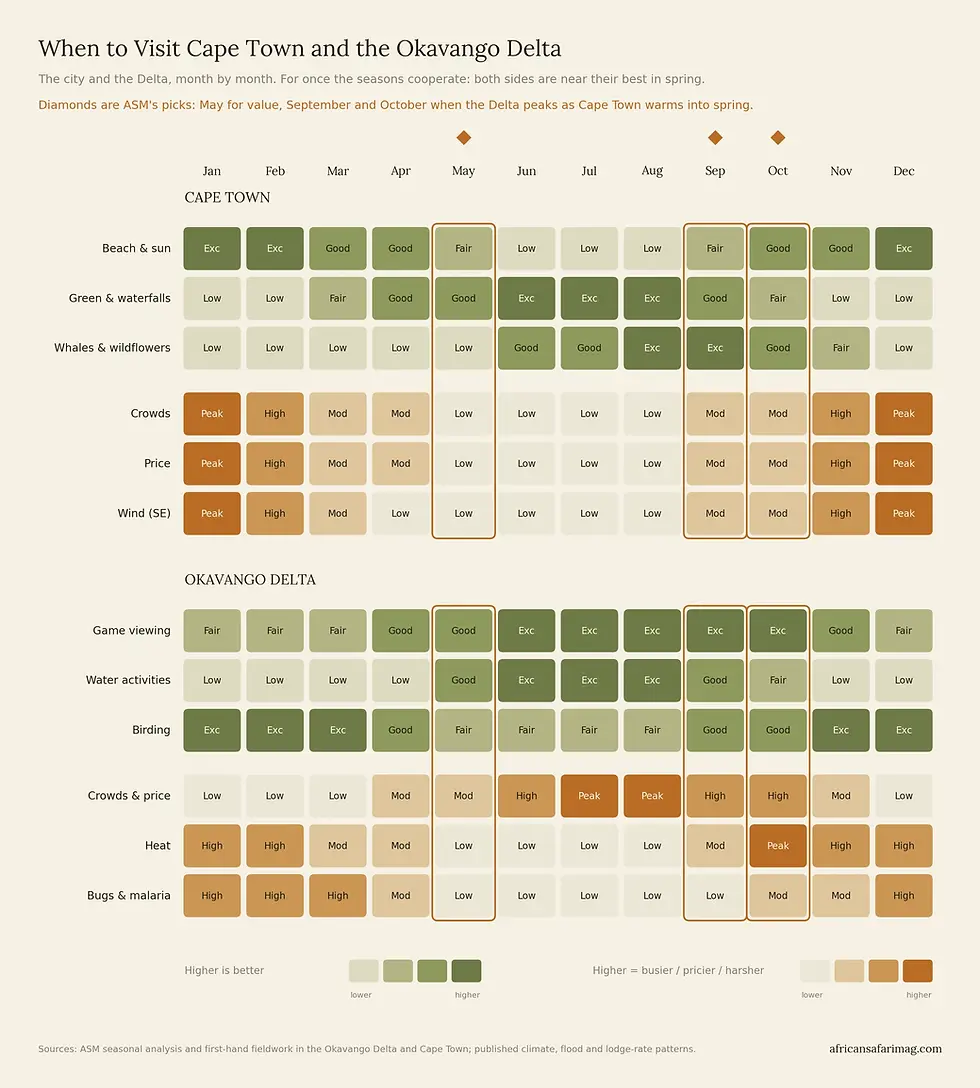
The seasons cooperate. Unlike Cape Town and Kruger, which pull against each other for much of the year (Cape Town gets winter rain exactly when Kruger's game viewing peaks), Cape Town and the Delta share a genuine sweet spot in September and October. More on that below.
And the trip scales. The same route works as a $9,000 trip and a $35,000 trip. The flight is the same. What changes is where you sleep.
Cape Town to Okavango Delta: how the route works
The journey has two legs, and the second one is half the fun.

Leg one: Cape Town to Maun.
Airlink flies direct from Cape Town International to Maun daily, departing mid-morning and landing in Botswana in the early afternoon after roughly two and a half hours. Return fares typically run around $500 to $800 depending on season and how far ahead you book. Maun is the gateway town to the Delta, and almost every safari in northern Botswana starts there. If the Cape Town direct is full or the times do not suit, you can route via Johannesburg, which has more frequency but turns a half-day of travel into most of a day.
Leg two: Maun into the Delta.
With a handful of exceptions, Okavango camps are fly-in only. From Maun you board a shared light-aircraft charter (or, at some camps, a helicopter) for a 15 to 45 minute hop to your camp's airstrip. Your camp or planner books this; it is not a flight you buy separately online. The mid-morning Cape Town departure is timed well for this: land early afternoon, clear immigration, and you are usually in camp for afternoon tea and the evening game drive. A delayed arrival past mid-afternoon can mean missing the day's last charter, which is one of several reasons the flights belong in professional hands rather than pieced together yourself.
The charter flight is also your introduction to the Delta. From a few hundred metres up you watch the Kalahari's dry scrub give way to a green and blue maze, with elephants wading the channels below you. I have flown into a lot of safari areas. Nothing else looks like this from the air.
The luggage rule that catches people out.
Light aircraft charters limit you to about 20kg per person in a soft-sided duffel bag, and that includes hand luggage and camera gear. Hard suitcases do not fit in the pods. Most travellers leave their main luggage in storage at their Cape Town hotel or at Maun airport and travel into the Delta with the duffel only. Camps provide daily laundry, so you need far less than you think.
Can you drive instead?
Technically, yes. Practically, no. It is well over 2,000 kilometres from Cape Town to Maun through the Northern Cape and across Botswana, two very long days of driving, and even then you cannot drive into most Delta camps, which sit on islands and concessions reached only by air or boat. Self-drive Botswana is a real and wonderful trip, but it is a different trip, built around Moremi's public campsites and a serious 4x4. For the lodge-based Delta experience this page covers, you fly.

How long do you need?
The honest minimum for the combination is seven nights: three in Cape Town, four in the Delta. Any less and you are paying long-haul airfare to skim both places.
The classic shape is ten to twelve nights. Three or four in Cape Town, five to six in the Delta split across two camps, and optionally a short extension (more on those later). Two Delta camps beat one longer stay at a single camp for most travellers, because the Delta is not one habitat. A water-focused camp and a game-dense land camp are close to different destinations, and the contrast between them is worth the extra charter hop.
On the Cape Town side, three full days covers the city's essentials: Table Mountain, the peninsula drive with the penguins at Boulders, a Winelands day in Stellenbosch or Franschhoek, and time to eat properly. Four days lets you breathe. A week is not too many if you add the Whale Coast or more of the winelands, but if those days are competing with Delta nights for budget, the Delta wins. Cape Town is the cheaper place to add time and the easier place to come back to.
Two rules of thumb I hold to. Never fewer than three nights in any Delta camp; the rhythm of camp life takes a day to settle into, and one-night stays waste half of each day on the airstrip. And if the budget forces a choice, trim city nights before lodge nights. Cape Town at $300 a night is not where the trip's magic concentrates.

Best time for a Cape Town and Okavango Delta trip
This is where the combination gets genuinely lucky. Cape Town has a Mediterranean climate: dry, warm summers from November to March and wet winters from June to August. The Delta runs on the opposite calendar in rainfall terms (its rain falls November to April) but its famous flood arrives from Angola months after the rain falls, peaking through the dry winter. The result is one clear overlap.
September and October is the sweet spot.
In the Delta, this is the late dry season: floodwaters still high enough for water activities in the right areas, vegetation thinning, and game concentrating around permanent water. It is the peak of the peak. In Cape Town, it is spring: the winter rain tapering off, the West Coast wildflowers finishing their run, and southern right whales at their most visible along the Whale Coast. Both destinations are close to their best in the same six-week window. Very few African pairings can say that.
The rest of the year is a question of which side of the trip you are prioritising.
June to August is prime Delta.
The delta is in peak flood, cool dry days, superb game viewing. Cape Town is in its winter, which means rain some days, green mountains, low crowds, log fires in the wine estates, and hotel rates well below summer. If the safari is the point and the city is the warm-up, this window is excellent, and it is when most safari-first travellers go.
November to March flips it.
Cape Town is in high summer, beach weather, at its most beautiful and its most crowded (mid-December to mid-January is peak local holiday season, and the city's hotel prices show it). The Delta is in its green season: hot, humid, afternoon storms, dispersed game, but also newborn animals, intense predator action, spectacular birding, and camp rates at their lowest. I have done the Delta in December and I would do it again: on one green-season stay I watched three wild dog hunts and a buffalo giving birth inside a few days. The green season trades comfort for drama and value, and it suits photographers and repeat safari-goers more than first-timers.
April and May is the quiet value window.
Cape Town autumn is arguably its loveliest weather of the year, still and clear after the summer wind. The Delta is in its shoulder: the flood arriving, rates below peak, camps quiet. If you want the trip at a fair price without green-season heat, May is the smart pick.
For the month-by-month detail on the Botswana side, our guide to the best time to visit the Okavango Delta goes deeper, including how camp choice changes the seasonal answer.
Where to stay in the Delta
The camp decides the trip more than any other choice you will make, and it is where the budget goes. Three honest tiers.
Accessible camps (roughly $500 to $1,000 per person per night, lower in green season) put you in the Delta ecosystem with shared charters, comfortable tents and genuine wildlife, often on the Delta's margins or in the Khwai and Moremi areas. This is how the combination becomes possible at around $8,000 to $12,000 per person all-in.
Premium camps (roughly $1,000 to $2,000 per person per night) buy you private concessions, low vehicle density, better guiding depth, and water-and-land flexibility. Most travellers who can stretch to this tier should; the concession exclusivity changes the experience more than the thread count does.
Ultra-luxury flagships (roughly $2,000 to $4,000 and beyond per person per night in peak season) are the Mombo and Jao tier: the finest wildlife real estate in the Delta with camps to match. A real quote we reviewed for an eleven-night, three-camp ultra itinerary in late 2027 came to just over $30,000 per person, fully inclusive of internal flights, which is what the top of this market genuinely costs.
I am not going to duplicate a lodge guide here. Our best Okavango luxury lodges guide ranks and compares the camps across all three tiers, including the water-versus-land question that should drive your shortlist.
My own most recent Delta stays were at Atzaro Okavango, twice in 2025, and the full review of that camp is its own page.
Three real itinerary shapes
These are grounded in real itineraries built and priced by the independent safari planners we route enquiries to, anonymised and current as of 2026 planning cycles. Prices are per person sharing, exclude international flights, and will vary with season, camps and exchange rates. Treat them as honest anchors, not quotes.
1. The value classic: 12 nights, Cape Town, Delta, Chobe and Victoria Falls
Three nights in a Cape Town boutique guesthouse, a morning flight to Maun and straight into four nights at an owner-run Delta camp, then three nights in the Chobe area for the river and its elephant herds, finishing with two nights at Victoria Falls before flying home from there. A real mid-2026 family version of this trip priced at R187,000 to R199,000 per person, roughly $11,500 to $12,300 at mid-2026 exchange rates, including domestic flights, transfers, and most meals and activities.
Best for: first-timers and families who want the full Southern Africa sweep at a defensible price.
Trade-offs: the pace is brisk (four beds in twelve nights), and the camps at this tier sit outside the most exclusive concessions. You see everything; you linger nowhere.
2. The grand tour: 15 nights, Whale Coast, Cape Town, Kalahari, Delta and Hwange
Three nights on the Whale Coast in a forest lodge above Walker Bay, three nights in a Cape Town boutique hotel, then Botswana in layers: three nights on the Makgadikgadi salt pans, three nights at a classic water-and-land Delta camp, and three nights in Zimbabwe's Hwange National Park, exiting via Victoria Falls. A real September 2027 version of this trip, built for two travellers at high-end but not flagship camps, priced at about $30,700 per person.
Best for: travellers with the time to treat Southern Africa as one continuous story rather than a city-plus-safari. The pans-then-Delta sequence, desert into wetland, is one of the great contrasts in African travel.
Trade-offs: fifteen nights and five properties demand stamina and a serious budget, and the Delta itself gets only three of those nights.
3. The Delta-deep ultra: 14 nights, Cape Town plus three flagship camps
Three or four nights in Cape Town, then the rest of the trip inside the Delta at three of its flagship camps, moving between concessions by light aircraft or helicopter. A real late-2027 quote for the eleven-night, three-camp Delta portion came to about $30,000 per person, fully inclusive, before the Cape Town nights. This is the version for people who have decided the Delta is the destination and Cape Town is the overture.
Best for: honeymooners, photographers, and second-visit travellers who want depth over breadth. Three camps means three habitats: this is how you see the whole Delta, not a corner of it.
Trade-offs: the price, obviously. And with no Chobe or Falls leg, you are choosing immersion over variety.
If I were building my own version tomorrow, it would be the shape in the middle of these: three nights in Cape Town, five or six in the Delta across one water camp and one predator-dense land camp, ten nights all in, in late September. That is the trip I would send a first-timer on without hesitation.
What the trip really costs
The Delta drives the budget. Cape Town, by safari standards, is cheap: excellent boutique hotels run $200 to $500 a night for the room (not per person), world-class dinners cost less than a mediocre meal in London or New York, and the big sights are inexpensive. Delta camps charge $500 to $4,000 per person per night depending on tier and season, and those rates are all-inclusive of meals, drinks, activities and usually the charter flights.

This produces a useful planning insight: adding Cape Town nights lowers your blended cost per night. The twelve-night value itinerary above works out to roughly $1,000 per person per night blended; the fifteen-night grand tour to about $2,000; the pure-Delta ultra leg to about $2,700. The city subsidises the average. It is also why trimming Cape Town to fund a better Delta camp is usually the right trade, while the reverse almost never is.
Realistic all-in bands for the combination, per person sharing, excluding international flights: $8,000 to $12,500 at the accessible end (shared charters, value camps, guesthouse Cape Town), $15,000 to $22,000 in the premium middle (private concessions, boutique-hotel Cape Town), and $25,000 to $35,000 and up for the flagship tier. September and October sit at the top of each band; green season can take 30 to 40 percent off the Delta portion.

One more honest line: this is not a trip that rewards aggressive bargain-hunting. The Delta's supply is deliberately tiny (that is why it feels the way it does), the good camps fill nine to twelve months out for the dry season, and the cheapest option in any tier is usually cheap for a reason a first-timer cannot see from a website.
I have done this trip. Here is what stays with you.
I grew up on the edge of the Greater Kruger and I live in Cape Town, so I am hard to impress with either half of this trip on its own. The combination is another matter.
What stays with me is the compression. On my last run I had a slow morning in Cape Town, mountain out the window, proper coffee, and by that evening I was in the Delta listening to a hippo argue with itself somewhere beyond the tent. One travel day. No time-zone change. It should not be that easy to swap worlds, and everywhere else in Africa, it is not.
The Delta itself earned its reputation on my December stays at Atzaro Okavango. Green season, so I got the heat and a couple of theatrical afternoon storms, and in exchange I watched wild dogs hunt three times in a handful of days and saw a buffalo calf take its first steps minutes after birth. We tracked the dogs with our guide across the concession on the last morning, and the highlights reel above ends with that sighting. I have been on a lot of game drives in my life. That week sits in the top tier of them.
If you take one piece of judgment from this page, take this: do not shave the Delta to make the trip cheaper. Shorten Cape Town, drop the extension, go in a value season, pick an honest camp in a lesser-known concession. But give the Delta the nights. It is the half of this trip you cannot approximate anywhere else on earth.

Extending the trip
The Cape Town to Delta spine takes extensions naturally, and most real itineraries carry at least one.
Victoria Falls is the classic add-on: a short flight from Maun or an easy road connection from Chobe, two nights is enough, and it hands you a dramatic final act plus an international airport to fly home from. Whether it earns its place on your trip is a genuine question, and our guide to whether to add Victoria Falls to your safari answers it honestly.
Chobe slots between the Delta and the Falls and delivers the river-boat safari and elephant density the Delta does not specialise in. Three nights is the right length.
The Makgadikgadi Pans are the connoisseur's add-on: lunar salt flats, meerkats, desert-adapted wildlife, and a landscape that makes the Delta feel even more miraculous when you arrive there afterwards. See the Botswana luxury safari guide for how the country's regions fit together.
On the Cape side, the Whale Coast (June to November for southern right whales) and the Winelands both extend the South African half by two or three unhurried nights, at city prices rather than safari prices.
Practical notes
Visas. Most Western passports (US, UK, EU, Canada, Australia and others) enter both South Africa and Botswana visa-free for tourism. Requirements change, so verify against your own passport before booking. South Africa applies strict documentation rules for travellers under 18, worth checking early if you are bringing children.
Malaria. Cape Town is malaria-free. The Okavango Delta is a malaria area, and prophylaxis is recommended; talk to a travel clinic four to six weeks before departure. If malaria-free is a hard requirement for your group, this is the wrong pairing, and Cape Town with Madikwe or the Eastern Cape reserves is the answer instead.
Money. Delta camps are effectively cashless once you arrive (everything is pre-paid or settled by card), and US dollars are the useful currency for tips in Botswana. Cape Town runs on cards almost everywhere. With that said, most tips are in cash, so make sure you take some cash for the guides, there are generally no ATMs at lodges.
Packing. One soft duffel under 20kg for the Botswana leg, layers for cold mornings and warm days, neutral colours for the bush, and whatever you like for Cape Town, left in storage while you are in the Delta. Binoculars are worth their weight; camps have them, but not always good ones.
Booking lead time. Nine to twelve months ahead for dry-season Delta camps, longer for the flagship camps in September and October. Cape Town hotels are easier, with the exception of mid-December to mid-January.

Frequently asked questions
How do you get from Cape Town to the Okavango Delta?
Fly. Airlink operates a direct flight from Cape Town to Maun daily, taking about two and a half hours and landing in the early afternoon. From Maun, a shared light-aircraft charter of 15 to 45 minutes takes you to your camp's airstrip, usually on the same afternoon. Your camp or safari planner arranges the charter leg.
Can you drive from Cape Town to the Okavango Delta?
Not practically. The drive to Maun is well over 2,000 kilometres and takes at least two long days, and most Delta camps cannot be reached by road at all; they are fly-in camps on islands and private concessions. Self-drive Botswana through Moremi with a 4x4 is a real trip, but it is a different trip from the lodge-based Delta safari this guide covers.
How many days do you need for Cape Town and the Okavango Delta?
Seven nights is the honest minimum: three in Cape Town and four in the Delta. Ten to twelve nights is the classic shape, allowing five to six Delta nights across two camps plus a possible extension to Chobe or Victoria Falls.
What is the best time of year for a Cape Town and Okavango Delta trip?
September and October. The Delta is at its dry-season peak for game viewing while Cape Town enters spring, with whale season on the nearby coast at its height. June to August favours the safari side (prime Delta, wet Cape winter), and November to March favours Cape Town (high summer in the city, hot green season in the Delta, with lower camp rates).
How much does a Cape Town and Okavango Delta trip cost?
Roughly $8,000 to $12,500 per person for a well-built value version, $15,000 to $22,000 at the premium level, and $25,000 to $35,000 or more for flagship camps, all excluding international flights. Real 2026 and 2027 planner quotes we reviewed ranged from about $11,500 per person for a twelve-night value itinerary to about $30,700 per person for a fifteen-night ultra-luxury version.
Do you need a visa for Botswana or South Africa?
Most Western passport holders, including travellers from the US, UK, EU, Canada and Australia, enter both countries visa-free for tourist stays. Rules change, so confirm current requirements for your passport before booking, and note South Africa's documentation requirements for minors.
Is there malaria on this trip?
Cape Town is malaria-free. The Okavango Delta is a malaria area and antimalarial prophylaxis is recommended; consult a travel clinic well before departure. Risk is lower in the dry winter months and higher in the green season.
Should you do Cape Town or the safari first?
Most itineraries start in Cape Town, and for good reason: it is the gentler place to recover from a long-haul flight, the direct flight to Maun departs mid-morning and connects cleanly into the Delta, and ending on safari means the trip builds rather than winds down. Starting with the safari works too, especially if you want Cape Town's restaurants as a soft landing afterwards. There is no wrong answer, only a default.
Can you do a short trip to the Okavango Delta from Cape Town?
The daily direct flight makes a short trip technically easy, and a four-night Delta escape from Cape Town is a realistic long-break trip. Below three nights in camp it stops making sense: charter costs and travel time stay fixed while the experience shrinks, and no camp reveals itself in two nights.
Ready to plan it?
Most readers will use this guide to shape the trip and approach camps or planners directly; the costs and trade-offs above are written for exactly that. If you would rather have it built for you, use Plan African Safari. Tell us your dates, budget and travel style, and we route your enquiry to the independent planner best suited to it. The service is free with no obligation, and we earn a commission only if a booking results.
You can also ask Savannah, our safari concierge, anything about this route first.
About the author
Craig Howes is the founder and editor of African Safari Mag. He grew up in Hoedspruit on the edge of the Greater Kruger, lives in Cape Town, and has spent two decades photographing and filming wildlife across Southern and East Africa. He has travelled the Cape Town to Okavango route himself, including two stays in the Delta in 2025, and was named Safari Influencer of the Year in 2020.
About African Safari Mag
African Safari Mag is an independent editorial guide to African safari travel. We do not sell trips. Our guides are built on firsthand travel, verified pricing, and itineraries from the vetted independent planners we route readers to. No lodge, camp or operator paid for inclusion on this page.


Comments