
Malaria-Free Safaris in South Africa: Which Reserves, What They Cost, and What You Give Up
Jul 27
17 min read
By Craig Howes, Founder and Editor · Updated July 2026 I grew up in Hoedspruit on the Greater Kruger boundary, and I have travelled both sides of South Africa's malaria line.
If you want a safari without malaria, South Africa is the answer. Not one of several answers. The answer!
That is not national pride talking. No other Big Five country has this much good reserve land sitting outside its malaria zone. Kenya and Tanzania have high-altitude pockets. Namibia and Botswana have arid corners. South Africa has entire provinces of it, with lodges, roads, airports and decades of conservation work behind them.
What nobody tells you is what the choice costs.
Because it does cost something. Sometimes money, since the malaria-free route runs from a self-drive weekend all the way to some of the most expensive beds in Africa. Sometimes wildlife, because the reserves with the highest big cat densities in the country all sit inside the malaria belt, and that is not a coincidence. And sometimes it costs you nothing at all, because for a family with a four-year-old the decision was never really open.
This page tells you which reserves are genuinely malaria-free, where the risk sits and when, what you are trading, and what it costs. It also corrects four claims currently circulating in the search results, one of which could get someone hurt.

Malaria-Free South Africa: The short answer, by place
Most searches that land here are really asking about one specific place. So:
Place | Malaria status |
Cape Town | No risk |
Johannesburg and Pretoria | No risk |
The Garden Route | No risk |
Madikwe Game Reserve | Malaria-free |
Pilanesberg National Park | Malaria-free |
The Waterberg, including Marakele | Malaria-free |
Addo Elephant National Park | Malaria-free |
The Eastern Cape private reserves | Malaria-free |
The Kalahari, including Kgalagadi | Malaria-free |
The Karoo | Malaria-free |
Kruger National Park | Malaria area, seasonal |
Sabi Sand, Timbavati, Klaserie, Manyeleti | Malaria area, seasonal |
Northern KwaZulu-Natal, including Phinda and Hluhluwe | Malaria area, seasonal |
South African National Parks states that of all its parks, only Kruger and Mapungubwe are malaria-risk areas. That one sentence does more work than any list a tour operator can hand you, and it is the reason the table above looks the way it does.

Not sure which side of the line your trip falls on?
Malaria-free is rarely a simple yes or no. It depends on where you are going, when, who is travelling and what you actually want out of the safari. We know these reserves, and we know which lodges suit which families. Tell us what you are planning, and we will point you to the right planner or property for your trip, not the one paying the most.
No cost, no obligation.

Malaria-Free and Low Risk Are Not the Same Thing
Malaria-free means there is no transmission. Low risk means transmission is reduced, usually by a dry winter, but has not stopped. The two get used interchangeably in safari marketing and they should not be.
There are two questions hiding inside every malaria-free search, and they need different answers.
The first is a hard requirement. You are travelling with a small child, or someone is pregnant, immunocompromised, or on medication that rules out prophylaxis. Or you simply will not enjoy the trip while carrying the worry. If that is you, the reserve list on this page is your answer and the rest is about choosing between them.
The second is a preference. You would rather not deal with malaria, but the wildlife is what you came for. The honest answer to that one is different, and it is worth saying plainly now rather than burying it: at the same nightly rate, dry-season Sabi Sand or Timbavati will out-deliver any malaria-free reserve in South Africa on big cats and on sightings per drive. What that costs you, in money and in risk, is set out further down.
Sabi Sand in June is low risk, not malaria-free
Sabi Sand sits inside South Africa's malaria area. Winter suppresses transmission substantially but does not eliminate it, and the same applies to Timbavati, Klaserie, Manyeleti and Kruger itself. A June trip to the luxury lodges of the Sabi Sand is a low-risk trip, not a malaria-free one, and anyone selling it as the latter is being loose with a health claim.
The distinction is not pedantry. It decides whether a family with a three-year-old can book the reserve at all.
The two official risk windows do not agree
South African National Parks puts the highest malaria risk in Kruger between November and April. The National Institute for Communicable Diseases frames the season more widely, September through May.
Both are credible authorities and they differ by four months. Plan on the wider window. Our guide to the best time for a South Africa safari covers how those months line up with game viewing, which is a separate calculation that often pulls in the same direction.

Why the map looks the way it does
Malaria needs people.
A female Anopheles mosquito has to bite someone who already carries the parasite, and the parasite then needs time developing inside her before she can pass it on. Temperature governs that development, which is why it stalls in cool conditions. The malarias that infect humans in Africa are not carried by wildlife, so the animals have nothing to do with it.
That explains the geography better than any list. Risk needs three things in the same place: warmth, low altitude, and people. Johannesburg sits too high. Cape Town is too cool and too far south. The lowveld along the Mozambique border has all three, which is exactly where South Africa's remaining cases are.
It does not make anywhere inside the belt safe. People live and work in these areas year-round. The mechanism explains the map. It is not a reason to relax.
What people actually do
I should be straight about my own practice, because it differs from what most travel pages imply.
I do not take prophylaxis on South African safaris. I sleep under the net when there is one, I use repellent, and there is usually a citronella candle going at dinner. Lodges in the Greater Kruger have this covered as standard: nets on the beds, repellent in the rooms, insecticide spray in the bathroom. Across many trips into the belt, including a December in Kruger with several days of heavy rain, I do not recall malaria being raised once. Not by a lodge, not at check-in, not by anyone in the vehicle. I do not know anyone who has contracted it on a South African safari.
That is an observation about how residents and repeat travellers behave. It is not advice and should not be read as any.
Someone who lives here and travels in the dry months and someone flying in for one trip of their life are making different calculations with different consequences. A first case of falciparum malaria in someone with no prior exposure is a serious illness.
The prophylaxis decision belongs to a travel clinic or your doctor, who will weigh your destination, your dates, your age, your other medication and your medical history. Take the reserve list on this page to that appointment. Do not take my habits.
Malaria-Free Safari Reserves in South Africa
The thing nobody explains: access
The gap between a malaria-free safari and a Greater Kruger one is not really about the animals. It is about access, and it comes down to three rules that never appear on a booking page.
In a private concession like the Sabi Sand, vehicles can leave the road, the traversing area is shared between a handful of lodges, and you sit in a small open vehicle. That combination is why the sightings are what they are. It also buys you activities a national park cannot offer, because private reserves can run night drives and walking safaris where SANParks rules generally cannot. That applies to the malaria-free reserves too: Kwandwe, Samara and Marataba can put you on foot or out after dark in a way Addo and Pilanesberg cannot, and for a lot of travellers that is the difference between two drives a day and an actual immersion. We go into this properly in our guide to South Africa's private game reserves.
In Madikwe, off-road driving is allowed but the reserve is shared by a long list of lodges all working the same ground. I stayed at Jaci's in November 2016, on a hosted media trip, and the density did not feel oppressive. We did wait our turn at a lion sighting because vehicles were already on it. It felt smaller than Kruger, which it is, and it felt good. The star beds are what I remember most. The reserve holds wild dog, which is part of why it is worth the drive, though we did not see them on that trip. That stay is nearly ten years old now and vehicle numbers change, so treat the density read as dated rather than current.
In a national park like Pilanesberg, there is no off-road driving at all. The animals are there in numbers. Getting a decent view of them is another matter, because the vehicle stays on the road and the sighting has to come to you.
There is a second thing that changes the experience and almost nobody mentions it, which is what you are sitting in. At the cheaper end you are often in a large safari truck with everyone loaded in together. The guide is trying to keep a full vehicle happy, so sightings get cut short and moved on from, and if you are on the wrong side of the truck you can spend a good part of the drive looking at the back of someone's head. A small open vehicle with six people in it is a different product, and part of what the price difference buys is exactly that.
Madikwe
Best for: a classic Big Five safari with wild dog in the mix.
Four to five hours from Johannesburg, up against the Botswana border. It is big, the game is genuine, and the lodge range runs from mid-tier to serious money. The trade-off is the shared traversing described above. If you want one malaria-free reserve that feels like a proper safari rather than a substitute for one, this is usually it.

Pilanesberg
Best for: short trips, tight budgets, and South African weekends.
I have been many times. It is full of animals and it is a genuinely South African day out, close enough to Johannesburg to make it easy. The lodges are not at the level you find in the private reserves, and the no-off-road rule means sightings are harder work than the animal numbers suggest.

For someone flying a long way for one safari, I would not send you here first unless time or budget made the decision for you. For a South African weekend, it is a different question entirely. If budget is the constraint, our budget safari guide for South Africa covers the alternatives.
The Waterberg
Best for: landscape, quiet, and a second safari that feels different from the first.
Rugged and mountainous, and it reads differently from the lowveld. The vehicle spends longer in shade and you can drive long stretches between sightings in a way you do not in the Sabi Sand. Marakele is SANParks and malaria-free, and Marataba operates as a private concession inside it, which is worth knowing if you assumed malaria-free meant the Eastern Cape. Welgevonden sits nearby and runs on a shared-traversing model with a limited number of lodges.

We have covered the region in detail, including Qwabi Private Game Reserve, the Babohi lodge, and Welgevonden Game Reserve.
The Eastern Cape
Best for: families, and anyone combining a safari with Cape Town or the Garden Route.
The most practical option in the country for a first safari with children. The reserves sit about an hour from the airport at Gqeberha and fold neatly into a coastal trip. They are private, well run and genuinely malaria-free.
Shamwari and Kwandwe are the names that come up most, both large private reserves with family programmes and, in Kwandwe's case, black rhino. Amakhala and Kariega sit a tier below on price. Addo is the accessible entry point, a national park rather than a private reserve, and one of the best places in the country to see elephant.
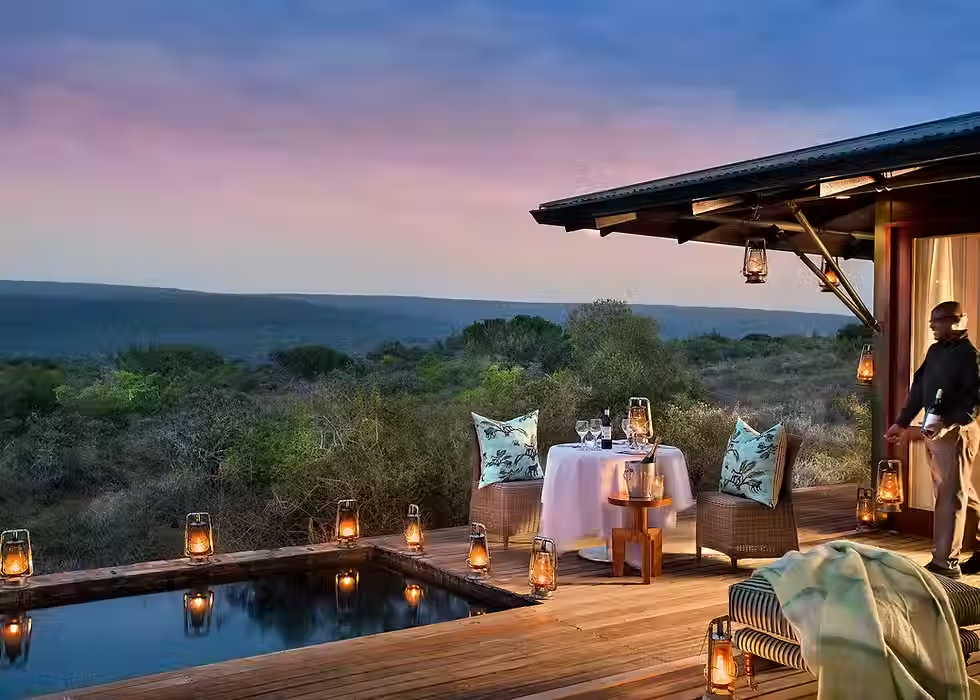
Two honest caveats. These are smaller, younger reserves than the northern ones, reintroduced rather than continuously wild, which some travellers notice and some do not. And there is a cost trap here that catches families, which I come to below. For the wider picture, see our guide to family safaris in South Africa.

The Kalahari and the Karoo
Best for: a second or third safari, and travellers who have already done the lowveld.
The arid reserves give you a different cast entirely. Springbok are a good example. They are South Africa's national animal and Kruger does not have them, because they belong to the dry country in the west and south. Seeing them wild in Namibia was one of those moments where you realise how much the habitat changes the trip.

Tswalu is the Kalahari's flagship and one of the most expensive lodges in Africa, built around meerkat, aardvark, pangolin and black-maned lion rather than a Big Five checklist.
Kgalagadi is the opposite end of the same landscape, a self-drive national park with a reputation for desert lions. Samara sits in the Great Karoo and is known for cheetah. The Karoo is also the easiest malaria-free safari to reach from Cape Town, with Sanbona and Inverdoorn within a few hours' drive and Gondwana out along the Garden Route.
I have not stayed at Tswalu, Samara or the flagship Eastern Cape reserves, so treat those as researched rather than reported.
There is more nuance here than a list can carry
Two reserves can both be malaria-free and be completely different trips. Vehicle numbers, minimum ages for game drives, whether a private vehicle is required for young children, how far you drive from the airport, and what the lodge actually charges once park fees land. Those are the things that decide whether the trip works.
We do not sell safaris. We know which planners and lodges fit which travellers, and we will point you at the right one for what you are actually trying to do.

What it costs, and what you give up
Malaria-free is not a budget category. This is the assumption I would most like to break.
At the bottom, Pilanesberg and Addo undercut almost anything in the Greater Kruger, and you can self-drive both.
At the top, the Kalahari's flagship lodges sit among the most expensive in Africa.
The malaria-free spread is wider than the Greater Kruger's, not lower. Our South Africa safari cost guide breaks down what the country costs by tier and season.
The trap in the middle
There is a specific one, and it catches families.
The Eastern Cape reserves sell to families through exclusive-use villas and private houses. It is a genuinely lovely product and it is the most expensive way to buy a safari. Published rack rates for exclusive-use villas in this bracket run into five figures per night before park fees.
For a family of five that can work out at ultra-luxury pricing per person, arrived at sideways.
A family that chose malaria-free because it sounded like the sensible option can end up quoted more than a couple doing Sabi Sand.
Nobody writes this down, because everyone selling it benefits from the villa booking.
Set against that, a course of antimalarials for a family of four is a small, fixed cost.
So what is the choice actually buying you?
If malaria-free is a hard requirement, none of this is a trade. Buy the best malaria-free reserve you can afford and you will get a very good safari, because Madikwe and the Eastern Cape are very good. Our best luxury safaris in South Africa guide covers the top end.
If it is a preference, be honest about the arithmetic. At the same nightly rate, dry-season Sabi Sand or Timbavati will out-deliver any malaria-free reserve in the country on big cats and on sightings per drive, for the structural access reasons above. That is a real difference and it is worth knowing before you spend the money.
Whether it is worth the risk is a conversation for your doctor, not for me.

The rest of Africa, and four claims worth correcting
South Africa is not the only place with malaria-free ground, but the alternatives are narrower than the search results suggest, and some of what is being published is wrong.
Etosha is not malaria-free.
This is the important one. Several widely cited pages describe Etosha as malaria-free or virtually malaria-free in the dry months. Namibia's own tourism authority classifies Etosha as a medium-risk area and recommends precautions through the November to April rainy season. Travel medicine sources place the Kunene region, which contains Etosha, at year-round risk and advise a suppressive regimen during the risk season. Namibia's health ministry also issued a malaria outbreak alert in early 2026 after a sharp rise in cases, with northern regions among those named. If you are planning Etosha, treat it as a malaria area and talk to a clinic. Our Namibia lodge guide covers the country's south, which is a different picture.
Phinda is not malaria-free.
It sits in northern KwaZulu-Natal, which is a seasonal malaria zone, and so does Hluhluwe. Both are excellent reserves. Neither belongs on a malaria-free list, and both currently appear on several.
South Africa is not the only African country that can offer this.
The World Health Organization has certified five African countries malaria-free: Mauritius in 1973, Morocco in 2010, Algeria in 2019, and Cabo Verde and Egypt in 2024. South Africa is not among them, because it still has local transmission in the northeast. What is true, and worth saying precisely, is that South Africa is the only major Big Five safari country with large, well-developed reserve areas outside its malaria zone.
Kenya's high-altitude safari areas are low risk, not malaria-free.
You will see Laikipia offered as the East African answer. Kenya's own county zoning does classify the central highlands, Laikipia among them, as low risk, because temperature at altitude slows the parasite. But the CDC recommends malaria prevention for all Kenyan areas below 2,500 metres including the game parks, and Laikipia sits around 1,700 to 2,000 metres. It is the same low-risk-is-not-malaria-free distinction that applies to dry-season Kruger, and it means Kenya does not really offer a malaria-free safari.
Dry season does not turn a malaria area malaria-free.
You will see this said about South Luangwa, Hwange and the Okavango. Reduced risk is not no risk, and none of those is a malaria-free destination in any season. You will also see operators state that antimalarials are unnecessary in low-risk areas. That is a medical recommendation, and a tour operator is not the right source for one.
Common questions
Is Kruger National Park malaria-free?
No. Kruger is one of only two SANParks parks classified as a malaria area, the other being Mapungubwe. Risk is seasonal, highest in the warm wet months and lowest in the dry winter. It is a low-risk destination in June and July, not a malaria-free one. If you are set on Kruger, our guide to where to stay in Kruger National Park covers the options.
Do I need malaria pills for a South Africa safari?
That depends on which part of South Africa, when, and who you are. It is a decision for a travel clinic or your doctor rather than for a website. If you are staying in Cape Town, the Garden Route, or any reserve on the malaria-free list above, the question does not arise. If you are going to Kruger, the Greater Kruger private reserves, or northern KwaZulu-Natal, take your dates and your medical history to a clinician.
Which parts of South Africa are malaria-free?
Almost all of it. The malaria area is the low-lying northeast: the Kruger lowveld in Mpumalanga and Limpopo, the border districts near Mozambique, Zimbabwe and Eswatini, and northeastern KwaZulu-Natal. Everywhere else, including every major city and the entire western and southern half of the country, has no transmission.
Which African countries are malaria-free?
Five have WHO certification: Mauritius, Morocco, Algeria, Cabo Verde and Egypt. None is a Big Five safari destination. What safari travellers actually want is malaria-free areas within safari countries, which is a shorter list than you would hope: most of South Africa, southern Namibia, and the Botswana Kalahari. Kenya is often added on the strength of altitude, but that does not survive checking. Kenya's own zoning puts the central highlands in a low-risk band, and the CDC advises prevention for every part of the country below 2,500 metres, which includes the game parks. Laikipia sits well below that line.
Is Sabi Sand malaria-free?
No. Sabi Sand is inside the malaria area. Winter substantially reduces transmission, which is why it is often described as low risk, but low risk and malaria-free are different things and the distinction matters if you are travelling with young children.
Is Cape Town malaria-free?
Yes, entirely, in every season.
How likely am I to get malaria on a South African safari?
Low, and lower still in the dry months, but low is not zero and nobody can give you a number for your specific trip. A clinician can weigh your dates, destination and health against current case data. That is what the appointment is for.
Can I do a malaria-free safari with a toddler?
Yes, and it is one of the better reasons to choose one. Check the lodge's minimum age for scheduled game drives before you book. Many of the better lodges have one, and families with younger children are often required to book a private vehicle at additional cost, which changes the price materially. Our family safari guide goes further on age policies and what to ask.
Get this one right
Malaria-free narrows the map. It does not make the decision for you.
The reserve that suits a couple wanting big cats is not the reserve that suits a family with a five-year-old, and neither is the one that suits a photographer chasing desert species. Add minimum ages, private vehicle rules, seasonal rates, park fees and how far you are prepared to drive from an airport, and the shortlist changes again.
We have been to these places. We do not sell safaris and we take no commission from lodges. What we do is match travellers to the planners and properties that actually fit, so the trip is built around what you want rather than around what somebody has spare.
Tell us who is travelling, roughly when, and what matters most. We will take it from there.
Plan your malaria-free safari · No cost, no obligation.
About the author
Craig Howes is the founder and editor of African Safari Mag, a wildlife photographer and a filmmaker.
He grew up in Hoedspruit, on the western boundary of the Greater Kruger, and has spent more than forty safaris across South Africa in every season. That includes the malaria-free reserves covered here and the private reserves inside the malaria belt, in the wet months and the dry. His wider fieldwork runs across Botswana, Kenya, Zambia, Zimbabwe, Namibia and the Indian Ocean islands.
He was named Safari Influencer of the Year at the World Travel Awards in 2020. He still thinks the best sighting of his life happened somewhere with no signal and no other vehicle in sight.
You can read more of his South African fieldwork in our guides to the best time for a South Africa safari and lodges around Hoedspruit.
About African Safari Mag
African Safari Mag is an independent editorial safari authority based in Cape Town. We are not a tour operator, and we do not sell safaris.
We visit the places we write about, we vet the operators and lodges we name, and we say plainly when we have not been somewhere. We take no commission from any lodge or reserve named on this page. Where we route an enquiry to a planning partner, we tell you.
That independence is the whole point. It is what lets us tell you that a malaria-free reserve might cost more than the alternative and deliver less wildlife, which is not something anyone selling you the trip has an incentive to mention.
Start with plan your African safari, or see work with us if you represent a lodge, reserve or operator.
How we sourced this page
Malaria status and risk seasonality are sourced to South African National Parks, the National Institute for Communicable Diseases, the World Health Organization, and Namibia's tourism and health authorities, linked at the claim each supports. Reserve and lodge detail comes from first-hand visits where stated and from direct operator verification otherwise, and we say which is which.
Where a stay was hosted, we disclose it in the paragraph where it appears rather than in a block at the end.
This page is not medical advice, and no page can be. Malaria risk changes by district and by season, and prophylaxis decisions depend on your health, your medication and your itinerary. Take this reserve list to a travel clinic and let a clinician make that call with you.


Comments