
Khamab Kalahari Reserve review: conservation first, lodges second
4 days ago
24 min read
By Craig Howes
Hosted stay, November 2026. Full disclosure at the end of this review.
Khamab Kalahari Reserve (styled !Khamab) is a private reserve of more than 90,000 hectares in the eastern Kalahari, in South Africa's North West province near the Botswana border. I stayed for four nights, from 9 to 13 November 2026. The stay was hosted.

I am writing this at Dinaledi, looking out over a waterhole with nothing behind it but Kalahari. A brown hyena is drinking in front of me as I type. I have been on more safaris than I can count and had never seen one until this week. Baboons, gemsbok, wildebeest and warthog have each taken their turn at the water too.
ASM Verdict
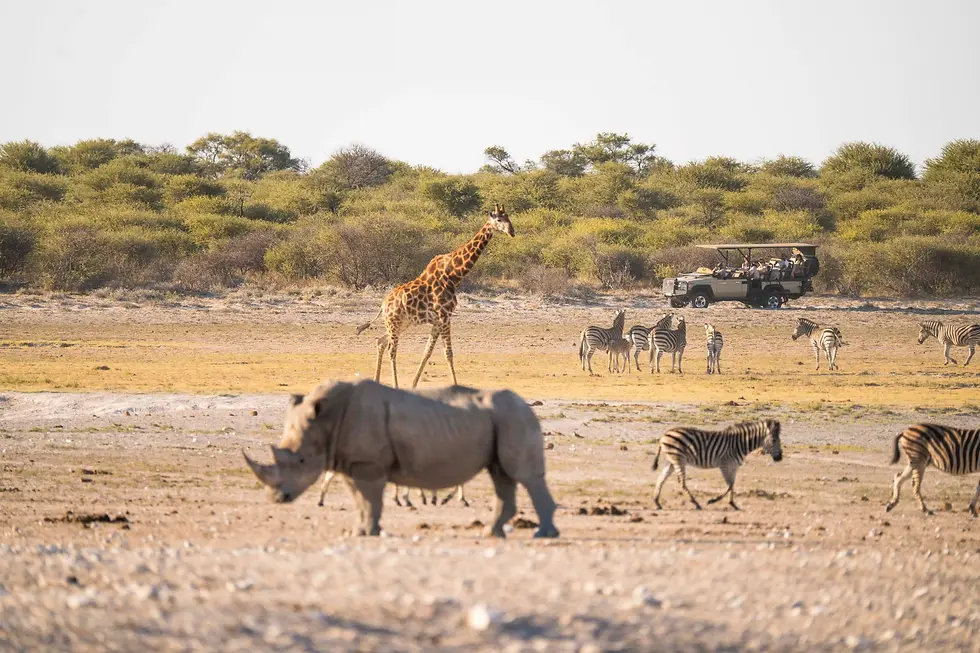
What it does well. The wildlife, above all. This was one of the best wildlife experiences I have had. There are animals everywhere, of many kinds, and because water is scarce they gather on the big open pans, where they are easy to see and fascinating to watch together. I have one photograph with lions and an elephant in the same frame, and another with buffalo, wildebeest and Burchell's sandgrouse. We saw animals you do not see in most other places, and some I had never seen: my first brown hyena, and black rhino for only the second time.
The guiding is excellent. The guides give you time at a sighting and can drive off-road. The photography is exceptional, with animals set against white pans and blue sky, and the pans themselves feel like another planet. The stargazing is the best I have seen in South Africa. The privacy is rare: three small camps on more than 90,000 hectares, and whole days without seeing another vehicle. And the reserve itself is the achievement, former cattle farms rewilded since 2007, with your stay helping to pay for it.
Where it falls short. Dinaledi is brand new, Kanako is not yet two years old, and both are still settling. Wi-Fi dropped at both camps we slept in, though the team worked hard to get it back. The air cooling in our Dinaledi suite did not work, and the room was too hot to sit in during the day. The food is uneven: an excellent breakfast and some very good dishes, and others that need work.
Best for. Repeat safari travellers who want a new environment, unusual sightings and an adventure. Photographers. Anyone who wants their money to go into conservation. Travellers after value, too: at Phênê and Kanako's prices, off-road driving with this much privacy is rare.
Not ideal for. Anyone who wants fine dining, polished luxury and perfect comfort, or a Big Five checklist in two days. A first-timer would still enjoy it, but it suits people who have been on safari before. Leopard are rarely seen here. If you struggle in heat, avoid early summer or look at Phênê.
Bottom line. This is a harsh environment, and the animals that survive in it make for unusual, spectacular sightings. You get real comfort within that. You leave with great stories, and with the sense that your stay helped pay for the reserve. It was one of the best safaris I have done.
Why Khamab exists: a reserve built for conservation
Khamab began in 2007, when the first of ten former farms was bought and the work of joining them into a single property started. More than 230 km of perimeter fence went up, the internal fences came down, and the slow work of turning farmland back into Kalahari began. By the reserve's count, around 6,500 animals were reintroduced in 2009 and 2010, and lions followed in 2010.

For nearly two decades the reserve earned almost nothing from tourism. "For 20 years, there's been no financial income gain from this reserve," Johan Odendaal, the managing director, told me. "20 years is a very long time."
In 2025 it was declared a Nature Reserve under national legislation.
You see the change most clearly at the water. The farms watered their cattle from cement troughs. Khamab pulled them out, and now pumps water into the natural calcrete pans instead, pale and wide and open to the sky. Sandgrouse, which have to wade in to drink, came back in numbers. So did the vultures.
"You can imagine 150 vultures are not going to sit around the farm cement dam," Johan said. "Now we see it regularly at all these pans." The reserve's 2026 game count found 25 vulture nests, up from 14 in 2024. Wayne told us white-backed vultures nest here.

The work reaches well beyond the fence. In 2019 a pack of 15 wild dogs left Khamab for Gorongosa National Park in Mozambique, where the species had been wiped out. The reserve's first elephants came from an elephant-riding operation. Today they are a wild, breeding herd that, as Johan put it, wants "nothing to do with humans".
This is a managed wilderness, and Khamab says so. Water is pumped, because fenced animals can no longer follow the rain. But dozens of the old farm water points have been taken out. "From a farming perspective, more water is better. From a wildlife perspective, more water isn't necessarily natural," says Hanno Kilian, the head ecologist, in the reserve's press material. Elephants are on contraception. Predators are moved out when numbers climb too high. Khamab is trying to rebuild a system that works, even where that means fewer animals. When the surplus water points came out, kudu and warthog numbers fell, and Johan sees that as a return to normal.
Rhino protection now shapes much of the work. When we visited in November 2026, the reserve had gone more than 1,000 days without a rhino poaching incident. Jethro Dell, the reserve's conservationist, puts that down to hard work, better technology, his tracking dog, Queenie, and methods he did not disclose. He and Queenie have a very special bond. The same protection covers pangolin, lion and leopard.

What Khamab is actually like
The setting and Sebodu Pan
Kanako sits on the edge of Sebodu Pan, a wide sweep of pale calcrete, and sooner or later everything that lives here seems to pass through it. It feels like a small migration played out in front of your tent: wildebeest first, then zebra, then springbok, and the lions after them. Two brown hyenas and two black rhinos came to the same water.

Johan says all roads lead back to this pan. He camped on this spot with his family in the years when the reserve was being put together, and he still calls it magical.
You can watch most of it without leaving camp. It is beautiful at sunrise and again at sunset, and after dark the guides hand out night-vision binoculars so you can follow who comes down to drink. Then you look up. There is no cell signal out here and no glow from any town, only the Milky Way over the pan. The reserve says its night sky has been assessed as Bortle Class 1, the darkest category there is, and it keeps a 14-inch telescope for stargazing.

We were told the pan's name refers to the smell of the water. From camp you barely notice it.
The camps
Khamab has three camps and only 15 rooms between them, for 30 guests at most, and each has its own character. Kanako feels like the Botswana wilderness, Dinaledi like luxury in the Kalahari, and Phênê like a well-run lodge from an earlier era.
Kanako Tented Camp
From about US$1,100 (R18,700) per person per night sharing (launch rate, as of November 2026).

Kanako is the expedition camp, opened in March 2025: seven tented rooms, off-grid, with a big boma facing the pan. Five tents stand alone and two interlead as a family unit. It feels like camping in the best sense, though it is hardly roughing it: your tent has an espresso machine, a fridge, an air cooler, couches and a mosquito net over the bed. That is an air cooler, not full air conditioning, which matters when it is 40 degrees outside.
Of the two camps, I preferred the boma here, and the view over the main pan. There was no pool when we stayed. One is being built, along with an observatory.
Dinaledi
From about US$2,010 (R34,000) per person per night sharing (launch rate, as of November 2026).
Dinaledi is the more polished camp, with only four suites. It opened in September 2026, two months before our stay. They look like tents from the outside, but inside you are in a proper room, with solid walls and big glass windows looking out over the Kalahari. The rooms and bathrooms are bigger, with one shower indoors and another outside. The food was a step up too, with two starters and two mains to choose from, served in an air-conditioned dining room.

Its waterhole is much smaller than Sebodu Pan and much closer, so when a brown hyena comes down to drink, it is right in front of you. Norma-Jean Naude, the manager who looks after both camps, is based here, and she was very good. A pool was due to open within days of our stay.

Moving to Dinaledi after two nights at Kanako felt like going from camping to a lodge, and I enjoyed them in that order.
The air cooling in our suite did not work properly, and in 40-degree heat the room was too hot to sit in during the day. The camp staff tried to fix it, and technicians came out the next day and were working on it before we left. We were about the fourth group to stay here, so I would expect it to be sorted by now. It is still worth asking if you are booking a summer stay.
Phênê Lodge
From about US$600 (R10,200) per person per night sharing (launch rate, as of November 2026).
Phênê is the original lodge, on the northern edge of the reserve, and it feels like a classic old-school South African safari lodge: thatched roofs, carved wooden doors, green lawn, a pool and a bar upstairs. The rooms are big. These are solid, air-conditioned buildings under thatch, and on our daytime visit it felt cooler than the tented camps. If you struggle with heat, it is the camp I would look at first. Ian, who runs the lodge, is also the chef. We went for brunch one day and did not sleep there.
Phênê has two units, each with two suites and a shared lounge, and it is the only camp that takes children aged 6 to 11. It is the closest camp to the sunken photographic hide, which is why photography groups favour it. Guests at any camp can use the hide, and the guides arrange it so each group has it alone. We understand an upgrade is planned, so the price may not last.
Food and service
The food was good overall, and uneven. Breakfast at Dinaledi was excellent, some dishes were very good, and a few needed work. The one I will remember is a braai in the boma, eaten with the Milky Way overhead. It is hard to find fault with dinner when the sky looks like that.
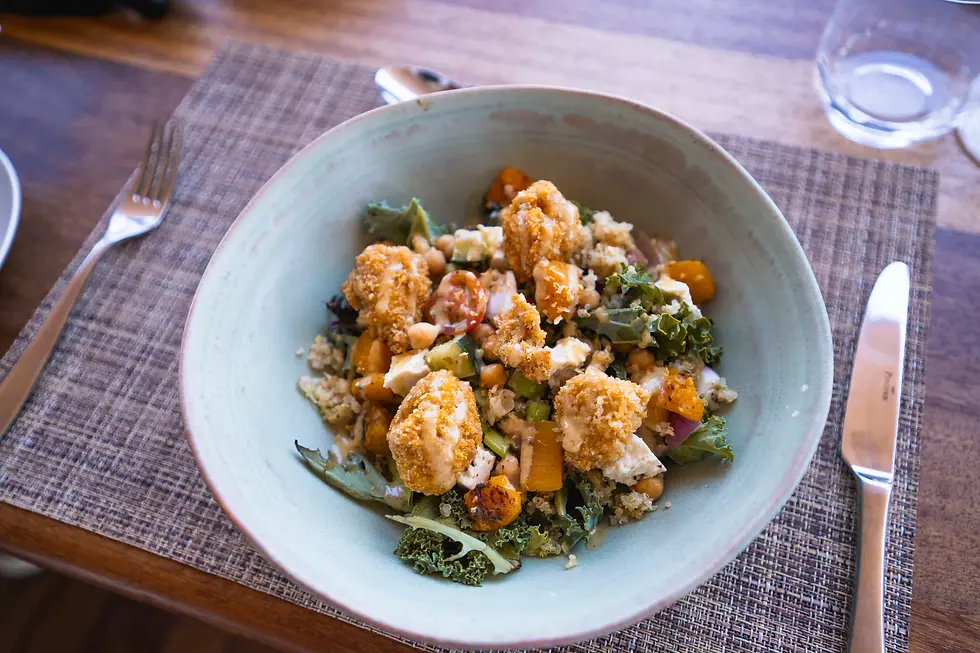
This is not fine dining, and the choice is narrower than at the top lodges.
That is deliberate. "This isn't about formal fine dining in the bush," head chef Louise Pretorius says in the reserve's press material. Come expecting that and you will eat well.
The team is small. Managers cleared plates and fixed things in the rooms themselves. Everyone we met worked hard and was kind. That is by design: we were told the reserve would rather spend on conservation than on a large staff. It also means service is simpler than the luxury label suggests. We were told more staff will be hired as bookings grow.
We met the people who run the reserve too: Johan, Hanno and Jethro. Hearing about the work from the people doing it was a highlight. We were on a media trip, so I cannot promise every guest the same access, but it is worth asking.
Where it is and how to get there
Khamab is remote, near Bray in North West province, and it is malaria-free. There are four ways in, as of November 2026.
Scheduled charter from Johannesburg. Flights run from OR Tambo on Thursdays and Sundays at about US$1,180 (R20,000) per seat each way. This is a promotional rate for travel before 31 December 2027.
Private charter. About 1 hour 15 minutes from Lanseria.
Road transfer from Kimberley Airport. About five and a half hours with an outside supplier.
Self-drive. A 4x4 is recommended. You park centrally and a guide drives you to camp. The gate is open from 08:00 to 18:00.
We flew by private charter from Cape Town International, which took about two and a half hours.

The airstrip is on a neighbouring farm, and the transfer to camp was a game drive of about an hour and a half. Khamab is building its own runway.
My advice: if you have the budget, or a group to split it, charter. Otherwise fly to Kimberley, which Airlink serves from both Cape Town and Johannesburg, hire a car and drive about five hours. A 4x4 is the safer choice. You can also drive from Cape Town or Johannesburg if you really want to. Our guide to fly-in versus drive-in safaris explains the trade-off.
Wildlife and game viewing: the honest version
Khamab is a fenced private reserve with no internal fences. It holds all of the Big Five. We saw four of them. One guide told us he had seen leopard about six times in a year. Two packs of wild dog live on the reserve. We did not see them.

What we did see was better than a checklist. The best moment came before we had even reached camp. We had been driving for about an hour from the airstrip, in real heat, when our guide Dean Laubscher, Khamab's head guide, pulled over for drinks in an area where he knew cheetah had been. He wandered off on his own, came back, and told us he had a surprise.
He took his rifle and led us out on foot, then pointed at a tree in the distance and asked whether we could see them. We stared, and none of us could. He only wanted to show us how well they hide. The cheetah were under a bush about 30 metres from where we stood: four brothers, a coalition he knows well.
He walked us around the bush so we could see them from every side, and they were entirely unbothered by us. I felt completely safe, and Dean was in control throughout. I have been on a lot of safaris and have grown harder to impress than I would like. This went straight into my top ten moments.

We also did a proper walking safari over the pans. That one was about tracks, the Kalahari sand and how the calcrete pans work. We saw lion several times, usually at water.

A brown hyena came to the waterhole in front of camp every day. Once, a second arrived five minutes behind it, which surprised me, since brown hyenas usually forage alone. I would happily have stayed longer just to watch how they get on.

We saw four of the Big Five without leaving camp. We saw rhino again and again over four days, including two black rhino, which I had only seen once before. In about ten days in and around Kruger in September, I saw one rhino. Elephant are few. We saw one, and it felt like an event.

The plains game is Kalahari game: gemsbok, red hartebeest and springbok, none of which live in Kruger. We saw meerkats too. After years of impala and wildebeest, I found myself excited about antelope again.
The small things are as good as the big ones. We sat for half an hour at Nare, a waterhole named for the Setswana word for buffalo, while more than a thousand Burchell's sandgrouse swarmed above the water and dropped onto the pan to drink. I have watched scenes like this on Planet Earth and wondered what it would be like to sit inside one. Now I know.

What they are doing is remarkable. Male sandgrouse wade in and soak their belly feathers with about two tablespoons of water, then fly it back to the nest, sometimes 20 to 30 km away, where the chicks drink it straight from the feathers. These are the birds that came back when the cement troughs came out.
Nobody rushed us. We could stay at a sighting as long as we liked and shape the drives around what we wanted to see. The guides build the days around you. If you want to stay out on a drive all day, spend a morning or an evening in the photographic hide, or go out to look at the stars, they will arrange it.
The guides can also leave the road, which you cannot do inside a national park like Kruger. The vehicles seat seven at most, with no middle seats. Wayne said the most he has driven is five.

Our last morning showed what that means. Lions had walked right past camp in the night, as they did on two nights of our stay, probably on their way to water. We wanted to find them, so Wayne made that the whole drive. With only us on the vehicle, he left the road and followed their tracks for about five kilometres through the bush, stopping to get out, read the sand and listen.
We never caught up with them. We got close, then ran out of time and had to turn for the airstrip. I did not mind at all. Watching Wayne read the tracks and explain what they were telling him was one of the best mornings of the trip, and along the way we found an aardwolf den, sandgrouse chicks and plenty of small things we would have driven straight past. Tracking lions can be more fun than driving from one sighting to the next.

Go out at night at least once. We saw porcupine, springhare, scrub hare, an African wildcat, a nightjar, lions and a black rhino, and at one point we simply sat and looked at the stars from the vehicle. The Kalahari even sounds different from Kruger after dark, with its own birds and its own insects.
Some of the smallest moments stayed with me. Walking back to our room, we found a green chameleon crossing the red sand outside the door.
The birding is good too. Dean pointed out secretary birds and kori bustards, both more than once, along with swallow-tailed bee-eaters, lilac-breasted rollers and yellow-billed hornbills. We saw waxbills, a goshawk and a vulture as well.

For photography it is exceptional. The pans are pale calcrete under big blue skies, so animals stand against clean, open backgrounds you do not get in thicker bush. We came home with beautiful pictures of giraffe out on the pans. If photography is the point of your trip, read our guide to choosing an African photo safari.
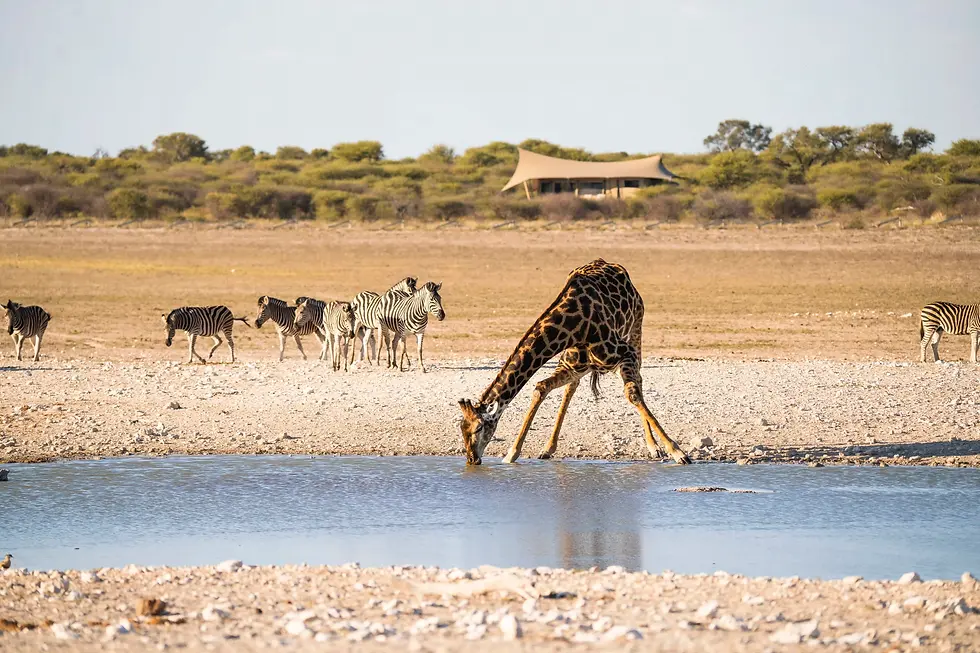
The guides are among the best I have had. Dean guided us for the first two nights and Wayne for the second two. When they are not driving guests, they cut roads and run vegetation surveys. It shows in how they explain the place.

My fiancée Nadya called it her favourite game viewing of any trip we have done.
Thinking of adding Khamab to your safari? Tell us where you're leaning and we'll match you with the right specialist to build it. It's free, with no obligation. Plan my safari
How Khamab compares
For context, the only better game viewing I can think of was at MalaMala, where we watched lions try to hunt a buffalo and saw leopard. My single best experience is still wild dogs hunting in the Okavango Delta, though not every day there was that good. At Royal Malewane we saw more, but with other vehicles around. At Khamab we had it to ourselves.

Tswalu Kalahari is the obvious neighbour in spirit, and far more established as a luxury product. It is larger in total, at 118,000 hectares by its own figures, but an electrified fence divides it into two sections with different predators, and it has no elephant. Khamab is a single system with no internal fences, where lion, cheetah and wild dog share the same ground, and it has all of the Big Five. One difference matters at the top end: Tswalu includes a private vehicle and guide with every booking, while at Khamab drives are shared unless you pay extra.
Madikwe, also in North West and also malaria-free, is the easier choice for a first Big Five safari. It has many more lodges and many more vehicles.
Greater Kruger wins on leopard and on density of sightings. Khamab wins on space, silence and species you will not see there.
If it is your first safari and you want the Big Five quickly, start elsewhere. If you have done Kruger and want something different, this is it.
What Khamab costs: rates and prices
Rates are per person per night sharing, from the reserve's rate sheet as of November 2026. Khamab quotes and invoices in rand. The dollar figures are our own conversions at R16.93 to the dollar on 14 November 2026, rounded to the nearest US$10, and they will move with the exchange rate.
Camp | Launch rate (book and prepay by 28 Feb 2027) | Low season (Mar to Apr 2027, Nov 2027 to Feb 2028) | High season (May to Oct 2027) |
Phênê | US$600 (R10,200) | US$730 (R12,365) | US$800 (R13,600) |
Kanako | US$1,100 (R18,700) | US$1,130 (R19,210) | US$1,250 (R21,130) |
Dinaledi | US$2,010 (R34,000) | US$2,060 (R34,925) | US$2,270 (R38,420) |
A single traveller pays 30% more. Children aged 6 to 11 pay half at Phênê. Dinaledi can be booked whole, for up to eight people, from about US$20,100 (R340,000) a night.
Included: all meals, game drives, guided walks, the photographic hide, house drinks, laundry, conservation levies and VAT.
Not included: flights and transfers, premium drinks and tips. Game drives are shared with other guests at your camp. A private vehicle costs extra and must be booked for the whole stay.
Children: no under-sixes anywhere. Kanako takes guests from 12 and Dinaledi from 16. Nobody under 16 may join a walk.
What four nights really costs. Flights change the sum. With the scheduled charter from Johannesburg at about US$1,180 (R20,000) each way, four nights at launch rates comes to:
Camp | Four nights | Return charter | Total per person |
Phênê Lodge | US$2,410 (R40,800) | US$2,360 (R40,000) | US$4,770 (R80,800) |
Kanako Tented Camp | US$4,420 (R74,800) | US$2,360 (R40,000) | US$6,780 (R114,800) |
Dinaledi | US$8,030 (R136,000) | US$2,360 (R40,000) | US$10,390 (R176,000) |
At Phênê the flights cost almost as much as the stay. Driving in from Kimberley is the cheaper way to get here. For how this compares with the rest of the country, see our South Africa safari cost guide.
Phênê and Kanako are where the value is. You get the same reserve, off-road driving and real privacy, a combination that is very hard to find at those prices. I only visited Phênê, so that is a judgement on its price and what I saw, not on a stay.
Dinaledi is the harder call. I really liked it: the rooms are better, breakfast was excellent and the wildlife comes closer. At about US$2,010 (R34,000) a night it sits in the same price bracket as South Africa's established luxury lodges, and during our stay the food and the cooling were still catching up with that. It is a brand-new camp, we were about its fourth group, and I expect it to settle quickly.
If you want the most comfortable room on the reserve, this is it. If budget matters, Kanako gives you the same reserve and the bigger pan for a little over half the price. I would like to come back and see Dinaledi once it has found its feet.
Khamab states that 100% of tourism income stays in the reserve. Johan put it more plainly. Your stay, he said, "is paying for that guy that's doing the anti-poaching patrol outside there now."
The model is not proven yet. The reserve does not cover its own costs. "We haven't arrived there yet," he told me.

When to visit Khamab
We went in November and it reached 40 degrees. That is normal for the Kalahari in early summer, so plan for it. You cannot go to Antarctica and expect not to get cold. Game still came to water all day, which made the pans rewarding.
The reserve describes a long hot season from about September to April, with thunderstorms, and a dry, cooler winter from May to August, with cold nights and mornings. The reserve prices May to October as its high season.
Wayne's pick is September. The worst of the winter cold is over, the heat and the rains have not arrived, and the bush is thin. The big rains come from February to April. Our guide to the best time for a South Africa safari covers the rest of the country.
We stayed four nights, two at each camp, and that felt right. The reserve recommends four nights too. Its minimum is two nights in low season and three in busy periods.

Pros and cons
Pros
Guiding of a very high standard
Cheetah, rhino and brown hyena in open country
Time at sightings, off-road driving, and drives shaped around you
Exceptional photography: animals on open white pans under blue skies
Sebodu Pan, watchable from your tent
Dark skies and real remoteness
Money stays in the reserve
Malaria-free
No other lodges, and whole days without seeing another vehicle
Cons
Leopard rarely seen; elephant few
Wi-Fi unreliable, no cell signal
New camps with teething problems: cooling, Wi-Fi and uneven food
Simpler food and service than a fine-dining lodge
Planning a trip that includes Khamab
If Khamab is your only stop, book direct with the reserve.
It works best as part of a longer trip. The scheduled flights from Johannesburg run only on Thursdays and Sundays, so they set the shape of the itinerary. It pairs naturally with Cape Town or the Winelands, or with a Greater Kruger lodge for leopard. Getting the order, the flights and the season right is where a planner earns their fee, and our guide to the best South Africa safari companies shows who we rate.
If you would like an introduction to a planner who can build Khamab into a trip, tell us about your safari. It is free, with no obligation, and we earn a commission only if a booking results.
Frequently asked questions
Where is Khamab Kalahari Reserve?
Khamab is in the eastern Kalahari, in South Africa's North West province near the Botswana border. The reserve calls it the green Kalahari: bushveld, with more grass, shrubs and trees than the red dunes many people picture. It is one of the most remote parts of the country.
How big is Khamab Kalahari Reserve?
Khamab covers more than 90,000 hectares, which is larger than Singapore. It has only 15 rooms and takes at most 30 guests. It describes itself as the largest private Big Five reserve in South Africa.
Is Khamab a Big Five reserve?
Yes. Lion, leopard, elephant, rhino and buffalo all live on the reserve. Leopard are seldom seen and elephant numbers are small, so do not expect all five on a short stay.
Is Khamab malaria-free?
Yes. Khamab is in a malaria-free part of South Africa.
Which Khamab camp should I choose?
Choose Kanako for the big pan and a tented, expedition feel. Choose Dinaledi for more comfort. Choose Phênê for a traditional thatched lodge, the lowest rates, solid air-conditioned rooms and the shortest drive to the photographic hide.
How much does Khamab cost?
From about US$600 (R10,200) per person per night sharing at Phênê, US$1,100 (R18,700) at Kanako and US$2,010 (R34,000) at Dinaledi, as of November 2026. Khamab quotes in rand, so the dollar figures move with the exchange rate. Those are launch rates for bookings prepaid by 28 February 2027. Meals, drives, walks and conservation levies are included. Flights are not.
How do you get to Khamab?
Most guests fly. Scheduled charters leave Johannesburg's OR Tambo on Thursdays and Sundays. You can also charter privately, or fly commercially to Kimberley and drive about five hours from there, by transfer or hire car. A 4x4 is recommended.
Is Khamab good for a first safari?
You would still enjoy it. But it suits people who have been on safari before and want a deeper experience of the Kalahari, which is how the managing director described it to us. If you want the Big Five quickly, start elsewhere.
What animals can you see at Khamab?
Khamab has all of the Big Five, plus cheetah, wild dog and brown hyena. The plains game is Kalahari game: gemsbok, red hartebeest and springbok. In four nights in November 2026 we saw four of the Big Five, cheetah, brown hyena and meerkat, but no leopard and no wild dog.
Can you drive off-road at Khamab?
Yes. Guides can leave the road to follow tracks or reach a sighting, and Khamab's are the only vehicles on the reserve. On our last morning our guide tracked lions off-road for about five kilometres.
Is Khamab good for photography?
Yes. The pale calcrete pans, red sand and open country give clean backgrounds, and animals gather at the waterholes. A sunken hide at water level near Phênê Lodge is included in the rate and open to guests at every camp.
Is Khamab a good alternative to Tswalu?
It is a different proposition in the same landscape. Khamab has all of the Big Five on one system with no internal fences, three small camps, and rates from about US$600 (R10,200) per person per night as of November 2026. Tswalu is larger and far more polished as a luxury product.
Is Khamab good for stargazing?
Yes. The reserve is far from any town and has no cell signal. The reserve says its night sky has been assessed as Bortle Class 1, the darkest category, and it keeps a 14-inch telescope for guests. An observatory is planned at Kanako.
Are game drives at Khamab private?
Not by default. Drives are shared with other guests at your camp, on vehicles that seat seven at most. A private vehicle costs extra and must be booked for your whole stay. While the camps are quiet you may well have a vehicle to yourselves, as we did on our last morning, but it is not guaranteed. You will rarely see another vehicle either way, because Khamab's three camps are the only ones on the reserve.
How long should you stay at Khamab?
Four nights. That is what the reserve recommends and what we did, with two nights at each of two camps. The minimum is two nights in low season and three in busy periods.
Is there Wi-Fi and cell signal at Khamab?
There is no cell signal. The camps offer Wi-Fi, but it dropped at both camps we slept in during November 2026, so do not rely on it.

Stay facts
When: 9 to 13 November 2026, four nights in total.
Where we slept: Kanako (two nights) and Dinaledi (two nights). We had brunch at Phênê but did not sleep there.
Hosted: yes. A media trip of eight, arranged by the reserve's PR agency, with charter flights from Cape Town.
Drives and walks: about six game drives, a night drive, a walking safari over the pans, an evening of stargazing, and night viewing of the pan from camp.
Weather: hot and dry, up to 40 degrees.
How full: both camps were full during our stay.
Who guided: Dean Laubscher, the head guide, from Kanako. Wayne from Dinaledi.
Who we spoke to: I recorded interviews with the managing director, Johan Odendaal, and with Wayne.
About the author
Craig Howes is the founder and editor of African Safari Mag. He was born in Hoedspruit, on the edge of the Greater Kruger, and works as a travel photographer and filmmaker. He has been on more safaris than he can count, including more than forty across South Africa, and hosts the African Safari Mag podcast, where he interviews planners, guides and lodge teams. He spent four nights at Khamab in November 2026. More about Craig.

About African Safari Mag
African Safari Mag is an independent editorial site that helps travellers make better safari decisions. We do not book trips or sell safaris, and no lodge or company can pay for a review or a ranking.
How this review was made. Khamab hosted our stay from 9 to 13 November 2026 and covered return charter flights from Cape Town, on a media trip arranged by its PR agency. No company paid for this review, and Khamab had no say over its tone or conclusions. Prices come from the reserve's rate sheet as of November 2026.
If you want help planning, Plan African Safari introduces you to a specialist planner we trust. It is free, with no obligation, and we earn a commission only if a booking results. Safari businesses can read about working with us.


Comments